Furigana guides
What Is Furigana? A Clear Guide for Learners
What is furigana? Learn how small kana readings support kanji, where Japanese readers encounter them, and how to use them without becoming dependent.
By Furiganaize Editorial TeamPublished 4 min read
What is furigana?
Furigana is the small kana printed above or beside kanji to show how a word is read. You will see it in textbooks, children's books, manga, games, names, and other places where a reader may need a pronunciation hint.
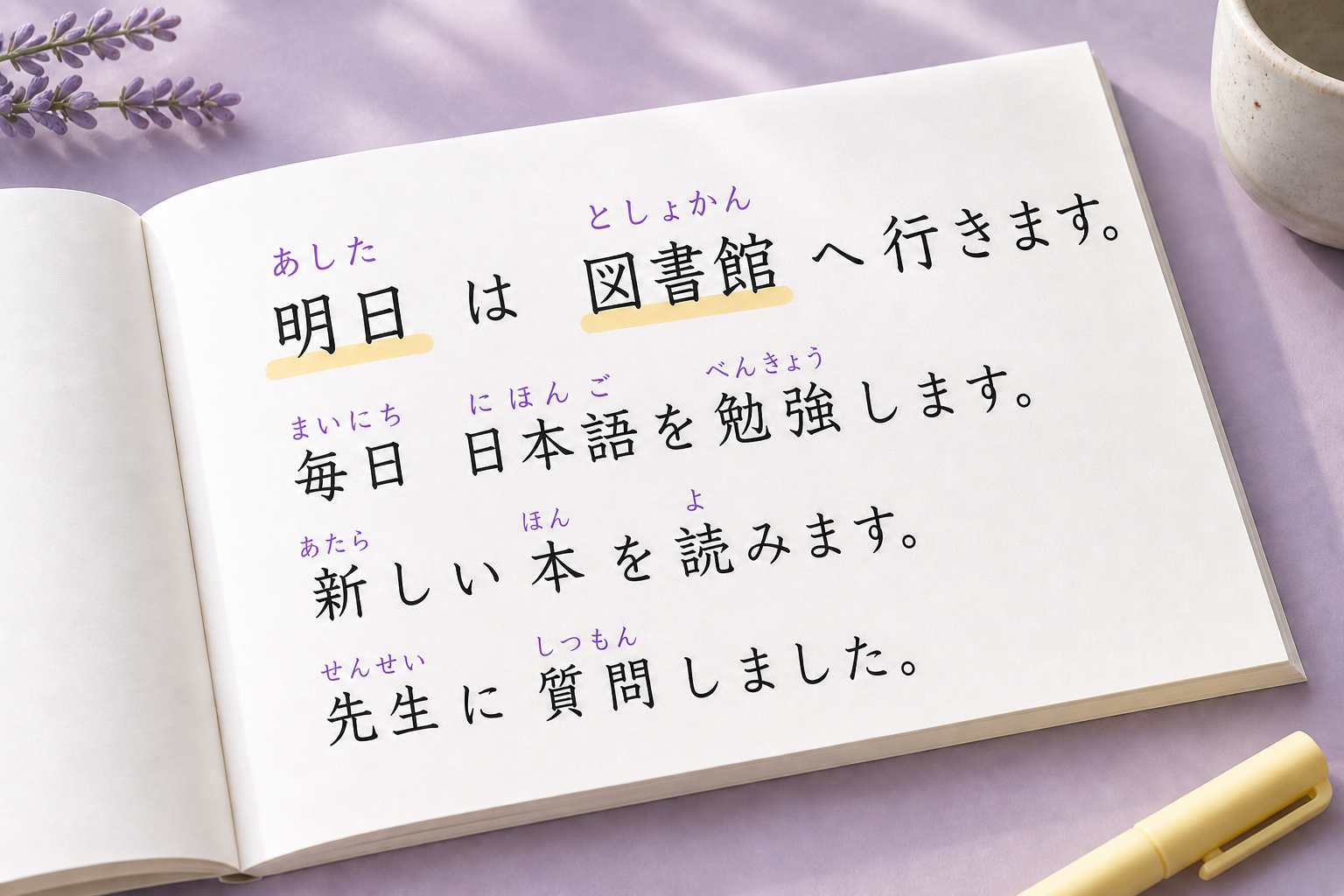
For learners, furigana works best as a temporary bridge.
Use it to get through a real sentence, notice the word, and then try the sentence again with less help.
What furigana shows
Japanese mixes kanji with hiragana and katakana, and the same kanji can be read differently in different words.
That is why furigana applies to the whole word, not just to each character.
Read separately, 今 is often いま and 日 is often にち. Together, 今日 is commonly read as “today.” Furigana makes that whole-word reading visible.
Furiganaize makes a strong first guess, but names, puns, neologisms, and unusual context may still need a dictionary or the readings the publisher printed in the book itself.
How to read a passage with Furiganaize
1. Start with something you actually want to read. A paragraph, a few subtitle lines, or a page of dialogue. Paste it into the Reader, or import a TXT, SRT, VTT, or EPUB file — up to 3,000 characters on the free plan.
2. Read the furigana version aloud. Tap only the words that stop you; the dictionary shows the meaning and the JLPT level. Save the ones worth keeping to your Wordbook instead of looking them up again next week.
3. Go back to the original. After a short break, re-read the same passage in its plain form and say what it meant in your own words. That final pass is what turns a lookup into memory, and the words you saved come back for a quick review the next day.
Choose the right output for the text
Here is the same intermediate-level sentence in each of the four formats.

Hiragana
昨日の会議で提案された新しい制度に、彼は難色を示した。
The default format, and the one to stay with. It matches how ruby is printed in Japanese books.
Katakana
昨日の会議で提案された新しい制度に、彼は難色を示した。
Here as a reference option rather than a recommendation. If your katakana is still slower than your hiragana, reading a sentence you already understand with the readings in katakana is a cheap way to practice the characters.
Romaji
昨日の会議で提案された新しい制度に、彼は難色を示した。
Useful in the first few weeks if you are not familiar with hiragana or katakana, but it hides the kana patterns you eventually need to read.
Parentheses
昨日(きのう)の会議(かいぎ)で提案(ていあん)された新(あたら)しい制度(せいど)に、彼(かれ)は難色(なんしょく)を示(しめ)した。
The readings sit on the line at full size, so they are easier on the eye than small ruby — and easy to cover up. Read the passage once with them visible, then put your hand or a strip of paper over the brackets and check whether you can still read the line without them.
Notice 昨日 in the first line. Character by character it would be さく and じつ, but as a word it is read きのう — the kind of reading you cannot assemble from the individual kanji, and exactly what furigana is there to show.
If you are not sure, use hiragana — it is the default, and it is what the rest of this guide assumes. Whichever you pick, the aim is the same: to need it less next time.
The Reading Habit That Builds Real Fluency
If you can pronounce every word but still cannot explain the sentence, the problem is grammar or vocabulary — not a lack of furigana. Furigana shows how a word is read; it cannot make it stay with you.
That part takes real work. So when a reading gets you through a word you didn't know, save it to your Furiganaize Wordbook and let it come back in your reviews — tomorrow, in a few days, next week. Every word you save is one less word that trips you up next time. That's what getting better at Japanese actually looks like.